

430 vs 304 Stainless Steel: What It Means for Your Bins

Last updated: October 2026
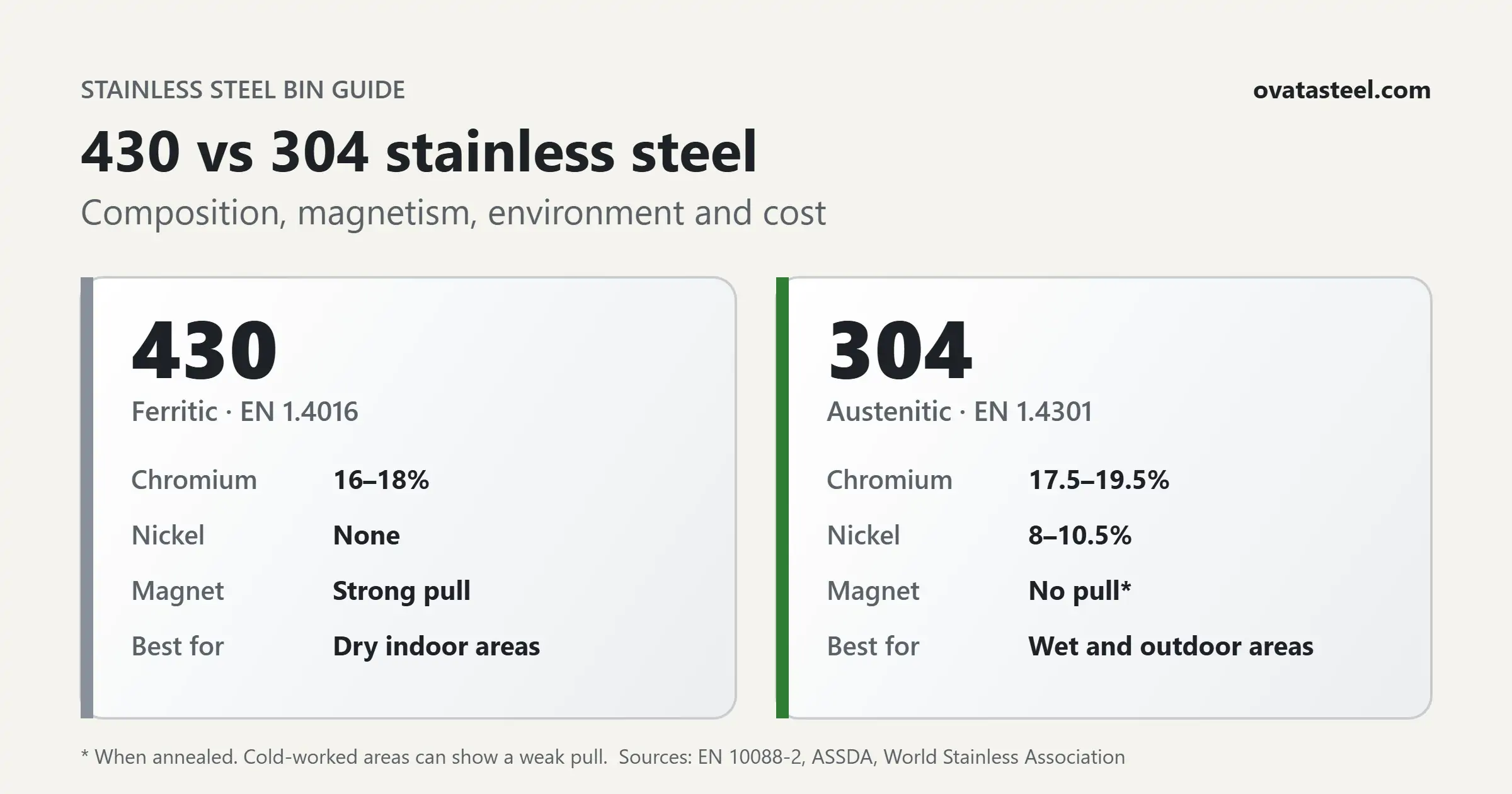
The main difference between 430 and 304 stainless steel is nickel: 304 contains roughly 8–10.5% nickel, while 430 contains none. That makes 304 more resistant to corrosion and the better choice for wet, outdoor and frequently cleaned areas, while 430 costs less and is usually enough indoors in dry conditions. For bins, the right grade depends on where they will stand.
This guide covers the composition of both grades, which one suits which environment, what a magnet test does and does not tell you, why 304 costs more, and how to specify the grade when you ask for a quote.
430 vs 304 stainless steel: the short answer
304 is an austenitic stainless steel containing chromium and nickel; 430 is a ferritic stainless steel with chromium but no nickel. 304 resists corrosion better and is easier to form and weld. 430 is magnetic, cheaper, and according to the World Stainless Association is mainly used as an alternative to 304 in indoor applications.
| Property | Grade 430 | Grade 304 |
|---|---|---|
| European designation | EN 1.4016 (X6Cr17) | EN 1.4301 (X5CrNi18-10) |
| Structure | Ferritic | Austenitic |
| Chromium | 16.0–18.0% | 17.5–19.5% |
| Nickel | None | 8.0–10.5% |
| Magnetic response | Strong | None when annealed; weak on cold-worked areas |
| Corrosion resistance | Good in mild conditions | Higher |
| Forming and welding | Forms well, limited weldability | Very good |
| Cost | Lower | Higher |
| Typical bin location | Dry indoor areas | Washrooms, kitchens, outdoors, frequently cleaned areas |
What are 430 and 304 stainless steel?
430 and 304 are AISI designations; their European equivalents under EN 10088 are 1.4016 and 1.4301. Chromium is what makes stainless steel stainless, because it forms a thin protective layer on the surface. The nickel in 304 changes the steel’s structure to austenitic, which improves corrosion resistance, formability and weldability.
| Grade | EN number | Carbon (max) | Chromium | Nickel | Molybdenum |
|---|---|---|---|---|---|
| 430 | 1.4016 | 0.08% | 16.0–18.0% | None | None |
| 304 | 1.4301 | 0.07% | 17.5–19.5% | 8.0–10.5% | None |
| 316 (for comparison) | 1.4401 | 0.07% | 16.5–18.5% | 10.0–13.0% | 2.0–2.5% |
Grade 304 is often called “18/8”, a shorthand for roughly 18% chromium and 8% nickel. Grade 316 adds molybdenum, which makes it more resistant than 304 in chloride and salt environments; it comes up again in the coastal section below.
Corrosion resistance: which grade for which environment?
In dry, enclosed spaces 430 is usually enough. The World Stainless Association says 17% chromium ferritic grades such as 430 work with intermittent water contact in non-severe conditions but are best suited to only mildly aggressive environments. Where there is constant moisture, outdoor exposure, frequent cleaning with chemicals or salt in the air, 304 is the safer choice.
| Environment | 430 | 304 | Note |
|---|---|---|---|
| Dry indoor (offices, corridors, meeting rooms) | Usually adequate | Suitable | 430 makes sense where budget comes first. |
| Hotel bedroom, dry area | Usually adequate | Suitable | Choose 304 if the bin sits in the bathroom. |
| Washroom, toilet, wet area | Limited | Recommended | Constant moisture and cleaning chemicals. |
| Kitchen, canteen | Limited | Recommended | Frequent washing and food residue. |
| Sheltered outdoor (under canopies) | Limited | Recommended | Rain does not wash the surface, so clean it regularly. |
| Open outdoor, urban | Not recommended | Recommended | Powder-coated bins are another option outdoors. |
| Coastal, marina | Not recommended | Staining risk | Wash often; severe marine sites need higher grades such as 316. |
| Outdoor pool surround | Not recommended | Suitable with regular washing | Standard grades are not recommended for saltwater pools. |
Near the sea, 304 can develop brown surface marks known as “tea staining” even when the steel is structurally sound. The Australian Stainless Steel Development Association (ASSDA) describes this as a problem of appearance and recommends choosing the grade by distance from the sea, specifying a smooth finish, avoiding water traps and crevices, and washing regularly.
Around pools, ASSDA considers 304 and 316 generally satisfactory for items that are regularly washed and not load-bearing, such as benches, ladders and rails. The International Molybdenum Association (IMOA) advises that 304L should not be exposed to chloride levels above 250 ppm and that common stainless steels should not be used in saltwater pools. For a poolside bin, the practical answer is 304 with regular fresh-water rinsing.
Is 430 stainless steel magnetic? What the magnet test tells you
Yes, 430 is magnetic, and a magnet gives a quick hint about which grade you have, but not a definitive answer. According to ASSDA, a magnet is strongly attracted to 430 but not to annealed 304; bent, pressed or otherwise cold-worked parts of 304 can still show a weak response. A magnet test does not measure corrosion resistance.
- Strong pull: most likely a ferritic grade such as 430.
- No pull: most likely an austenitic grade such as 304.
- Weak pull on edges or bends: could still be 304; forming can create a magnetic response.
- For a definite answer: use a portable XRF analyser, a spot test or laboratory analysis. ASSDA notes that the mill certificate is usually sufficient unless there is reason to doubt it.
So “if a magnet sticks, it is poor quality” is a myth. 430 is a genuine stainless steel; it simply has a different structure and suits different conditions.
Why 304 costs more than 430
The price gap comes mainly from nickel: 304 contains about 8–10.5%, 430 contains none. In a refrigerator example, the World Stainless Association puts the cost of 430 30–40% below austenitic stainless steel, while component maker Essentra says 430 is often about 55–75% of the price of 304, with the ratio moving as metal prices change.
Material is only one part of a bin’s price. Sheet thickness, labour, the lid mechanism and the inner liner all affect the total, so ask for both grades on the same quote if you want to compare.
Choosing a grade by location
Location decides the grade. In dry indoor areas, 430 stainless steel bins keep costs down; in washrooms, kitchens, pool areas and outdoors, 304 stainless steel bins keep their appearance for longer. The table below is a starting point based on the sources in this guide, not a fixed rule.
| Location | Suggested grade | Why |
|---|---|---|
| Office, meeting room, corridor | 430 | Dry and cost-effective. |
| School corridor, classroom | 430 | Dry indoor use; check sheet thickness for impact resistance. |
| Shopping centre interior | 430 or 304 | 304 if bins are wiped with detergent daily. |
| Hotel bedroom | 430 | Dry area; 304 for the bathroom bin. |
| Hotel and office washrooms | 304 | Moisture and cleaning chemicals. |
| Hospital, clinic | 304 | Frequent disinfection and washing. |
| Commercial kitchen, canteen | 304 | Water, grease and food waste. |
| Pool deck, spa | 304 | Chlorinated water splashes; rinse regularly. |
| Park, garden, street | 304 or powder-coated | Rain, sun and dust. |
| Seafront hotel, marina | 304 with frequent washing | Salt air can stain; severe sites need a higher grade. |
Specifying grade in a quote or tender
A supplier can only recommend the right grade if it knows where and how the bins will be used. When you request a quote or write a tender, state the grade, the location, whether it is indoors or outdoors, the distance from the coast and the cleaning products in use. These details affect both the price and how long the bins keep their finish.
- Model, capacity in litres, or dimensions
- Grade: 430 or 304 (write the EN number too if your specification uses it: 1.4016 or 1.4301)
- Location: office, washroom, kitchen, pool deck, outdoor
- Distance from the sea and climate (humidity, salt air)
- Cleaning and disinfection products used on site
- Sheet thickness and surface finish, if you have a requirement
- How you want the grade confirmed, for example a mill certificate
- Quantity and delivery country
Cleaning and care for both grades
Even the right grade can stain if it is cleaned the wrong way. ASSDA advises avoiding household cleaners that may contain chloride activators or bleach, and washing and rinsing stainless steel regularly with fresh water. Carbon steel particles, including those from steel wool, can cause brown marks. These rules apply to both 430 and 304.
- Wipe with a soft cloth, warm water and mild detergent, then rinse with clean water and dry.
- Do not use bleach, hydrochloric acid or chlorine-based cleaners on stainless steel.
- Avoid steel wool and wire brushes; scratches and carbon steel contamination start stains.
- On brushed finishes, wipe along the direction of the polishing lines.
- Do not let water collect in the base or around the lid; wash the inner liner separately.
- Wash more often outdoors and near the sea; surfaces that rain does not reach get dirty faster.
Ovata’s 430 and 304 options
Ovata Steel manufactures its stainless steel products in 430 or 304 grade, depending on what the customer asks for, and exports to every country. Price and lead time depend on the product and quantity and are set in the quote. State the grade you want and where the products will be used, and we can discuss which grade suits your project.
- Bins: stainless and painted models in waste bins, multi-compartment units in recycling bins and street models in outdoor trash bins.
- Outdoor ashtrays: both grades appear in the range, for example the Ovata-204 with a 430 stainless body and the Ovata-214 with a 304 stainless top. See all outdoor ashtrays.
- Wet areas: grab bars such as the Ovata 1316 and pool showers such as the Ovata-1202 are listed in 304. See grab bars and outdoor showers.
To compare both grades for the same model, send us your quantities and the location.
Frequently Asked Questions
Does 430 stainless steel rust?
430 is a stainless steel and resists corrosion well in dry indoor conditions. The World Stainless Association says 17% chromium ferritic grades such as 430 are best suited to only mildly aggressive environments. With constant moisture, outdoor exposure, salt air or chlorine-based cleaners, staining and corrosion are more likely than with 304.
What is the difference between 304 and 430 stainless steel?
304 is an austenitic stainless steel with about 8–10.5% nickel; 430 is a ferritic stainless steel with no nickel. 304 resists corrosion better and is easier to form and weld. 430 is magnetic and cheaper. Use 430 in dry indoor areas and 304 in wet or outdoor locations.
Is 304 stainless steel magnetic?
Annealed 304 is not magnetic. According to ASSDA, parts that have been bent, pressed or otherwise cold-worked can show a weak magnetic response. A slight pull on the edge of a bin therefore does not prove it is not 304. XRF analysis or a mill certificate gives a definite answer.
Does a magnet sticking mean the stainless steel is poor quality?
No. A magnetic response shows that the steel has a ferritic or martensitic structure, not that it is poor quality. 430 is a magnetic stainless steel widely used indoors. A magnet test does not measure corrosion resistance; it only gives a hint about the structure.
Which grade should I choose for washroom bins?
Choose 304 for washrooms, toilets and other wet areas, where there is constant moisture, splashing and frequent use of cleaning chemicals. A 430 bin may be fine in a dry hotel bedroom, but near showers and basins 304 keeps its surface appearance for longer.
Can 304 stainless steel bins be used by the sea?
Yes, with regular washing. Salt air can cause brown “tea staining” on 304, which ASSDA describes as a problem of appearance. Rinse the bins often with fresh water, choose a smooth finish and avoid designs that trap water. Severe marine sites call for higher grades such as 316.
How much more does 304 cost than 430?
It depends on metal prices. Essentra says 430 is often about 55–75% of the price of 304, and a World Stainless Association example puts 430 30–40% below austenitic grades. Sheet thickness, labour and the lid mechanism also affect a bin’s price, so ask for both grades on the same quote.
How do I clean stainless steel bins?
Wipe with a soft cloth, warm water and mild detergent, then rinse with clean water and dry. Avoid bleach, hydrochloric acid, chlorine-based cleaners and steel wool. On brushed finishes, wipe along the polishing lines. Clean more often outdoors and near the sea.
Sources
- EN 10088-2 composition values: RoyMech, “Stainless Steels to EN 10088”
- World Stainless Association, “Ferritic Stainless Steels”
- ASSDA, Technical FAQ 4: Testing for Grade Confirmation
- ASSDA, “Seven ways to prevent tea staining of stainless steel” (updated 15 May 2023)
- ASSDA, “Stainless steel for indoor swimming pools” (updated 29 June 2023)
- IMOA, “Stainless steel swimming pool design”
- Essentra Components, “304 vs. 430 stainless steel: what’s the difference?”

