

Simpler Recycling: Which Bins Do Workplaces in England Need?

Last updated: October 2026
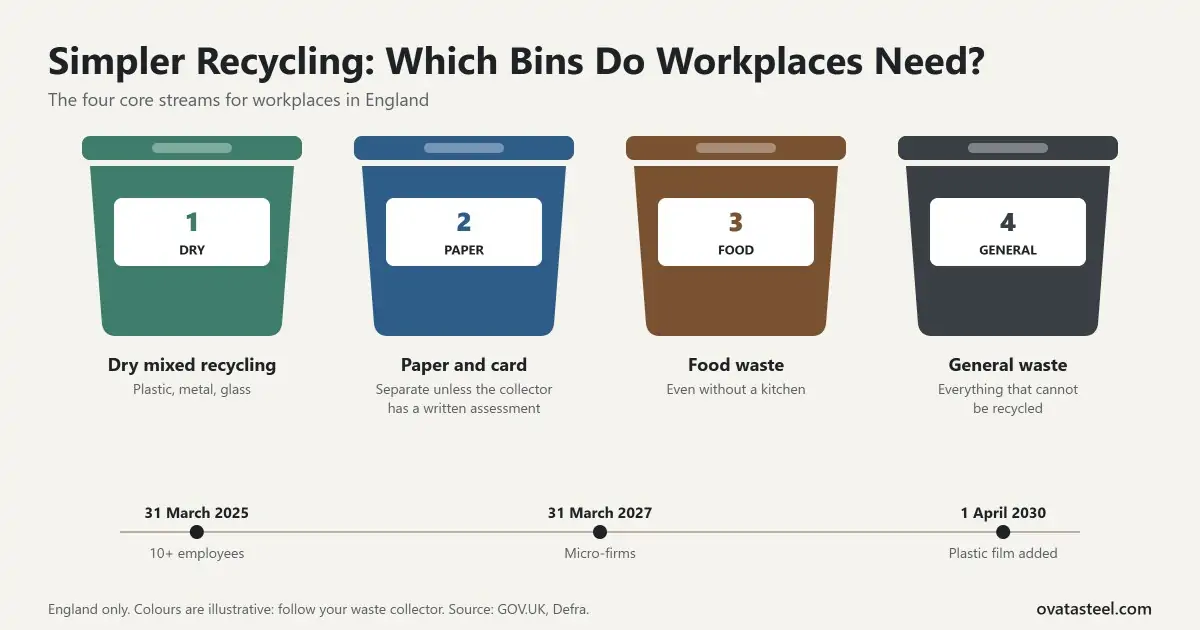
Under Simpler Recycling, most workplaces in England need four separate bins or collections: dry mixed recycling (plastic, metal and glass), paper and card, food waste and general waste. The rules have applied to workplaces with 10 or more full-time equivalent employees since 31 March 2025, and micro-firms with fewer than 10 have until 31 March 2027.
This guide explains which workplaces are covered, which Simpler Recycling bins you need and what goes in each, which streams can share a bin, the food waste rules, how to count employees as a micro-firm, and what changes next. It is based on the UK government’s guidance for workplaces in England.
Simpler Recycling at a glance
Simpler Recycling is the set of rules that makes every workplace in England separate the same core materials for recycling. It applies to businesses, charities and public sector organisations, and covers waste from staff, customers and visitors alike. The table below sums up the main points.
| Question | Answer |
|---|---|
| Where does it apply? | England only |
| Who must comply? | All businesses, charities and public sector organisations that produce waste similar to household waste |
| Since when? | 31 March 2025 for workplaces with 10 or more full-time equivalent employees |
| Micro-firms | Fewer than 10 full-time equivalent employees: by 31 March 2027 |
| Streams to separate | Dry recycling (plastic, metal, glass, paper and card), food waste and general (residual) waste |
| Paper and card | Kept apart from plastic, metal and glass unless the waste collector has a written co-collection assessment |
| Visitor bins | Covered: waste from customer and visitor bins must be separated too |
| Bin colours | Not set nationally; follow your waste collector |
| Enforcement | Environment Agency, through compliance notices |
| Next change | Plastic film and flexible packaging in the plastic stream from 1 April 2030 |
Which workplaces does Simpler Recycling cover?
Simpler Recycling covers almost every non-household premises in England. The government’s guidance names offices, shops, hospitality, schools, hospitals, care homes, places of worship, factories, warehouses, construction sites and event venues, and says the list is not complete. If your premises produce waste similar to household waste, the rules are likely to apply.
- Offices
- Retail and wholesale: supermarkets, pharmacies, convenience stores, garden centres and service station forecourts
- Hospitality: cafes, restaurants, pubs, takeaways and hotels, plus holiday parks, campsites and short-term rentals
- Transport: trains and stations, buses and coaches, domestic vessels and ports, and airports
- Education and health: schools, colleges, universities, GP surgeries, hospitals and care homes
- Venues: cinemas, theatres, galleries, theme parks, zoos, stadiums, arenas and temporary event venues, including outdoor events
- Industry: factories, workshops, warehouses, construction sites and agricultural premises
- Community premises: charities and charity shops, places of worship, residential hostels, penal institutions and premises used mainly for public meetings
Simpler Recycling applies in England only. Wales and Scotland have their own workplace recycling laws, which we compare in our guide to choosing an office recycling station.
The Simpler Recycling bins most workplaces need
Most workplaces need four Simpler Recycling bins: one for plastic, metal and glass, one for paper and card, one for food waste and one for general waste. You can use a separate bin for each stream, or separate waste before collection. The table lists what the government’s guidance says goes in each stream and what usually does not.
| Bin | What goes in | What usually does not |
|---|---|---|
| Dry mixed recycling: plastic | Bottles, rinsed food pots, tubs, trays and tubes, drinks cartons | Items labelled compostable or biodegradable (including coffee pods), polystyrene, PVC packaging, bulky rigid plastics |
| Dry mixed recycling: metal | Drinks cans, rinsed food tins, empty aerosols, aluminium foil, trays and tubes | Laminated foil pouches, batteries and electricals (including vapes), kitchenware, large aerosols and 5-litre cans |
| Dry mixed recycling: glass | Drinks bottles, rinsed food jars | Drinking glasses, window glass, glass cookware, light bulbs, mirrors, vases, ceramics, candles |
| Paper and card | Newspapers, envelopes, boxes, cardboard food packaging | Tissues, toilet paper, wet wipes, hygiene products, books |
| Food waste | Leftovers, peelings, fruit cores, coffee grounds, tea bags, food preparation waste | Compostable packaging (caddy liners are allowed) |
| General waste | Anything that cannot be recycled in the streams above | Recyclables and food waste |
Batteries and small electricals are not part of dry recycling. Collect them separately, for example in a battery waste box, and hand them to a suitable collection service.
Which streams can share a bin?
Plastic, metal and glass can be collected together in one dry mixed recycling bin. Paper and card must be kept separate from them, unless your waste collector has completed a written co-collection assessment showing that separate collection is not practicable or brings no significant environmental benefit. Food waste always needs its own container.
- Plastic, metal and glass: one bin is fine, usually collected loose or in clear bags as your collector instructs.
- Paper and card: a separate bin by default. If your collector’s written assessment allows co-collection, it can go in with the other dry recyclables. Ask your collector which applies to you.
- Food waste: never mixed with other streams.
- Garden waste: if your workplace produces it, arrange for it to be recycled or composted where that gives the best environmental outcome.
- Collections: you can set bin sizes and collection frequency to match your volumes, and use more than one collection provider.
Food waste: required even without a kitchen
Every workplace in scope must arrange food waste collection, even if it has no kitchen and does not serve food, and whatever the amount. Staff should not be asked to take food waste home. The guidance recommends weekly or fortnightly collection and says food waste should not be stored for more than two weeks.
- What goes in: leftovers, banana skins, apple cores, coffee grounds, tea bags and food preparation waste.
- Packaging: compostable packaging does not go in food waste. Caddy liners, including compostable ones, do.
- Cooking oil: small amounts can go with food waste or into a used cooking oil collection; never down the drain.
- Where to put food bins: wherever food waste is likely, such as staff rooms, tea points and canteens. Checking general waste bins shows where food waste is ending up.
- Composting on site: allowed, subject to the composting rules, though most workplaces cannot compost all their food waste effectively.
Micro-firms: how to count your employees
A micro-firm has fewer than 10 full-time equivalent employees and has until 31 March 2027 to comply. The count covers the whole business, not each site. A business with three locations and five employees at each has 15 employees, so it is not a micro-firm and must separate recycling at every location now.
- Part-time staff: count each as a fraction based on pro-rated hours.
- Who does not count: volunteers, contractors and self-employed workers.
- No application: micro-firms do not need to register or apply for the extra time.
- Planning ahead: 31 March 2027 is the last date, so ordering bins and arranging collections in advance avoids a rush.
Bins for customers and visitors
Waste from bins you provide for customers and visitors is covered by Simpler Recycling and must be separated too. Best practice is to give visitors separate dry recycling bins and, where food is likely to be eaten, food waste bins. Visitor bins also show customers that the business recycles properly.
- Front of house: a multi-compartment station at reception, shop entrances and waiting areas keeps visitor waste separated at source.
- Cafes and food courts: pair dry recycling with a food waste opening and general waste.
- Outdoors: outside seating, car parks and entrances need weather-resistant bins; see our outdoor trash bins.
- Separating before collection: if you keep single visitor bins, the waste must be sorted before it is collected.
Bin set-ups by type of workplace
The legal minimum is the same everywhere, but the right bin set-up depends on where waste is produced. The table below suggests a starting point for common workplaces, based on the four core streams. Adjust it to what your waste collector accepts and where waste actually builds up on site.
| Workplace | Where waste is produced | Suggested set-up |
|---|---|---|
| Office | Tea points, printers, reception, meeting rooms | 3-compartment stations (dry mixed, paper and card, general) plus food caddies at tea points |
| Shop | Stockroom packaging, staff room, customer bins | Large card collection for packaging, dry mixed and general bins, staff food caddy, customer recycling bins |
| Cafe, restaurant, pub | Kitchen, front of house | Kitchen food waste bins, glass and dry mixed recycling, general waste; customer bins with a food opening |
| Hotel | Rooms, kitchen, lobby, events | Kitchen food waste, stations in lobby and corridors, separation by housekeeping before collection |
| School, college | Classrooms, corridors, canteen, playground | 2-compartment bins in classrooms, 4- or 5-compartment stations in corridors, canteen food waste |
| Warehouse, factory | Packing areas, canteen, offices | Bulk card and plastic packaging containers, office stations, canteen food waste |
| Place of worship, community hall | Kitchen, hall, events | Kitchen food caddy, one multi-compartment station in the hall |
For a step-by-step guide to the number of compartments, placement and sizing in offices, see how to choose an office recycling station.
Contamination, enforcement and reporting
The Environment Agency enforces Simpler Recycling in England. It can issue compliance notices to workplaces, waste collectors and landlords or facilities managers who present waste for them, and failing to comply with a notice is an offence. Contaminated recycling can also be refused or charged extra by the collector.
- Reduce contamination: give clear instructions and signs, and watch how bins are used; change signs, bin locations or the number of bins if the same mistakes repeat.
- If a bin is badly contaminated: dispose of it as general waste and discuss it with your collector.
- Inspection: if the Environment Agency finds contamination, it says it will take a “pragmatic and proportionate approach” to enforcement.
- Collectors: must keep separated recycling separate, recycle or compost it, and be registered on the Public Register of Waste Carriers, Brokers and Dealers.
- Reporting: anyone can report a non-compliant workplace or waste collector to the Environment Agency through GOV.UK.
Bin colours are not set nationally. Research published in August 2026 counted at least 80 bin colour combinations across 190 councils, so follow your collector’s colours and label every bin. Our guide to recycling bin colour codes explains why labels matter more than colours.
What changes next: plastic film from 2030
Plastic film, such as bags and wrapping, is not yet part of the required plastic stream. Defra’s 2024 policy update planned film collections from households and businesses by 31 March 2027, but on 16 July 2026 Defra confirmed that mandatory collection of plastic films and flexible packaging is delayed to 1 April 2030.
Until then, check whether your collector already takes plastic film. From 1 April 2030, plastic film packaging and plastic bags are expected to go into the plastic recycling stream, so allow for that when you plan bin capacity.
Choosing bins that fit Simpler Recycling
Good Simpler Recycling bins make the four streams obvious and easy to use: one clearly labelled opening per stream, removable inner buckets for quick emptying and a size that matches your collection frequency. Ovata Steel manufactures metal multi-compartment recycling bins in Istanbul, Türkiye, with removable inner buckets; several models include a battery box.
| Model | Compartments | Size | Inner buckets | Simpler Recycling use |
|---|---|---|---|---|
| Ovata-420 | 2 | 30 × 90 × 70 cm | 2 × 45 L | Dry mixed + general in meeting rooms or classrooms |
| Ovata-437 | 3 + battery box | 27 × 73 × 70 cm | 3 × 40 L | Dry mixed, paper and card, general |
| Ovata-433 | 4 + battery box | 27 × 97 × 70 cm | 4 × 40 L | All four core streams |
| Ovata-432 | 5 + battery box | 27 × 120 × 70 cm | 5 × 40 L | Four streams plus glass kept separate |
See the full recycling bins range. We export to every country, including the UK. To request a quote, send the models or number of compartments, the stream for each compartment, the quantity and the delivery address; the price and delivery time are confirmed in the quote.
Frequently Asked Questions
What bins do I need for Simpler Recycling?
Most workplaces need four: dry mixed recycling for plastic, metal and glass; paper and card; food waste; and general waste. Paper and card can share the dry recycling bin only if your waste collector has a written co-collection assessment.
When does Simpler Recycling start for businesses?
It has applied since 31 March 2025 to workplaces in England with 10 or more full-time equivalent employees. Micro-firms with fewer than 10 full-time equivalent employees have until 31 March 2027.
Do I need a food waste bin if my workplace has no kitchen?
Yes. The government’s guidance says food waste must be collected even if the workplace does not serve food or have a kitchen, whatever the amount, and staff should not be asked to take food waste home.
Can glass go in the same bin as plastic and cans?
Yes. Plastic, metal and glass can be collected together as dry mixed recycling. Paper and card should be kept separate from them unless your waste collector has completed a written co-collection assessment.
How do I know if my business is a micro-firm?
Count full-time equivalent employees across the whole business, not per site. Part-time staff count as a fraction based on their hours; volunteers, contractors and self-employed workers do not count. Fewer than 10 means you are a micro-firm.
Do customer and visitor bins have to be separated?
Yes. Waste from bins provided for customers and visitors is covered. Provide separate recycling bins, plus food waste bins where food is eaten, or sort the waste before it is collected.
Who enforces Simpler Recycling?
The Environment Agency. It can issue compliance notices to workplaces, waste collectors and landlords or facilities managers, and failing to comply with a notice is an offence. Anyone can report non-compliance through GOV.UK.
Does Simpler Recycling include plastic film?
Not yet. In July 2026 Defra confirmed that mandatory collection of plastic films and flexible packaging is delayed to 1 April 2030. Until then, ask your collector whether it accepts film.
Sources
- Simpler recycling: workplace recycling in England – GOV.UK (Defra), updated 3 October 2025
- Simpler Recycling in England: policy update – GOV.UK (Defra), 29 November 2024
- Simpler Recycling: flexible collections to be delayed to 2030 – letsrecycle.com, 16 July 2026
- Simpler Recycling FAQs, July 2026 – Grundon Waste Management
- Inconsistent recycling bin colours are creating compliance challenges for UK workplaces – Workplace Insight, August 2026

