

Recycling Bin Colour Codes by Country: UK, EU, Gulf and Türkiye

Last updated: October 2026
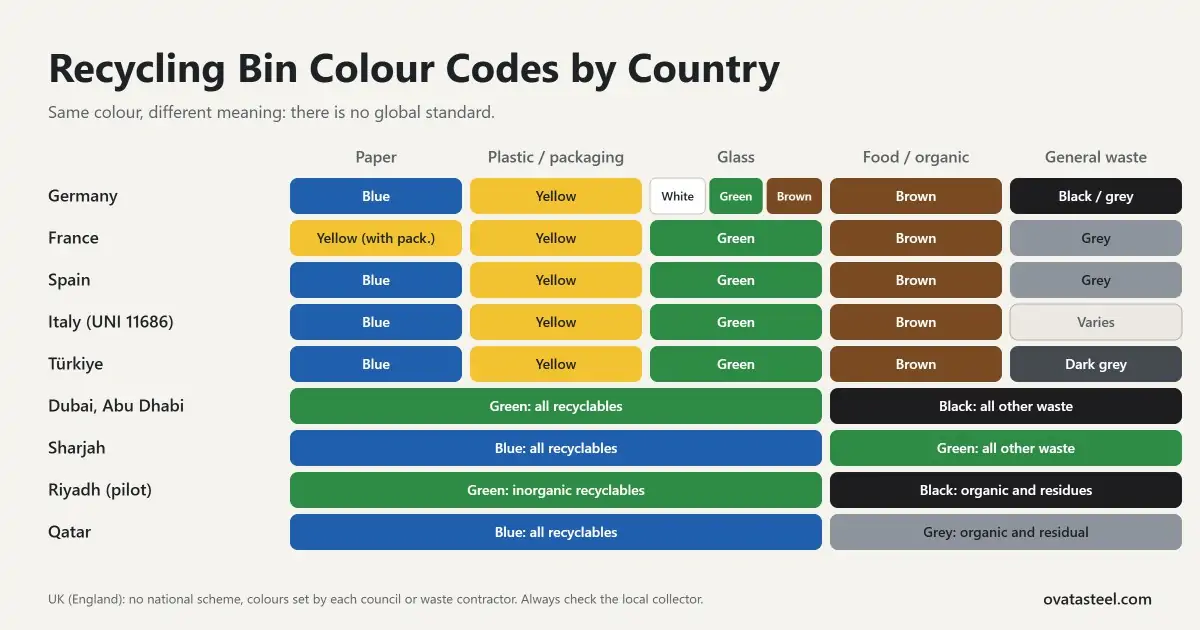
There is no global standard for recycling bin colour codes (or “color codes” in US spelling). Each country, and often each city, sets its own scheme, so the same colour can mean different things. Green is used for glass in France, Spain and Türkiye, for all recyclables in Dubai and Abu Dhabi, and for general waste in Sharjah.
This guide compares the bin colours used in the United Kingdom, the main EU markets, the Gulf and Türkiye. It also explains the EU’s upcoming harmonised waste-sorting labels and lists what to check before you order multi-compartment recycling bins for a site in another country.
Recycling bin colour codes at a glance
The table shows the colours most commonly used for each waste stream. Treat it as a starting point rather than a rule. In every market listed, the final colour is decided by the municipality, the waste collector or the tender specification, and neighbouring towns can use different colours for the same material.
| Market | Paper and card | Plastic / packaging | Metal | Glass | Food / organic | General waste |
|---|---|---|---|---|---|---|
| United Kingdom (England) | No national scheme. Colours are set by each council or waste contractor. | |||||
| Germany | Blue | Yellow (all packaging except glass and paper) | Yellow (with packaging) | Bottle banks by glass colour: white, green, brown | Brown (green in some areas) | Black or grey |
| France | Yellow (with packaging); blue where collected separately | Yellow | Yellow (with packaging) | Green | Brown | Grey |
| Spain | Blue | Yellow (light packaging) | Yellow (cans) | Green | Brown | Grey (dark green in some towns) |
| Italy (UNI 11686, voluntary) | Blue | Yellow | Varies by municipality | Green | Brown | Varies by municipality |
| UAE: Dubai and Abu Dhabi | Green (all recyclables in one bin) | Black (all other waste) | ||||
| UAE: Sharjah (Bee’ah) | Blue (all recyclables in one bin) | Green (all other waste) | ||||
| Saudi Arabia: Riyadh pilot | Green (inorganic recyclables) | Black (organic waste, food and residues) | ||||
| Qatar | Blue (all recyclables in one bin) | Grey (organic and residual waste) | ||||
| Türkiye | Blue | Yellow | Grey | Green | Brown | Dark grey |
In Germany, France and Spain, plastic and metal packaging share one yellow bin, and in France paper usually goes in it too. The Gulf programmes are two-stream: one bin for all recyclables and one for everything else.
Why recycling bin colours differ between countries
Bin colours follow the collection system, and collection systems differ. Some places collect all dry recyclables together, others separate paper, packaging and glass, and many now add food waste. Collection is usually run by local government on long bin-replacement cycles, so changing a colour scheme means replacing or relabelling thousands of containers.
A 2026 bachelor’s thesis at LUT University in Finland compared bin colours in Europe, the USA, Asia, Africa, the Middle East and Oceania. It found that blue is generally used for recyclables and green or brown for organic waste, but that one colour often has several meanings, and that colour coding only works when it is backed by public education and consistent enforcement.
United Kingdom: same streams, different colours
England has no national bin colour standard. The Simpler Recycling rules fix which materials a workplace must separate, not which colour each bin must be. Households get their colours from the local council, and businesses usually get them from their waste contractor.
What the rules require for workplaces in England:
- Who: workplaces with 10 or more full-time equivalent employees since 31 March 2025. Micro-firms with fewer than 10 have until 31 March 2027.
- Which bins: separate bins for general (residual) waste, mixed dry recycling and food waste. Paper and card must be kept apart from other dry recyclables unless your collector has assessed that collecting them together is justified.
- Food waste: it must be collected even if the workplace has no kitchen or does not serve food.
- Visitor bins: if you provide bins for customers or visitors, that waste must be separated too.
The colours themselves vary widely. Research by the commercial waste company Direct365, based on Freedom of Information requests and published in August 2026, found at least 80 different bin colour combinations across 190 local authorities. General waste often goes in a black or grey bin, but blue, green and other lid colours are used for different streams from one council to the next.
For a UK site, match the colours your waste contractor uses and label every opening with the stream name and a pictogram. Organisations with several sites can use one internal scheme backed by clear labels. This section covers England; Wales, Scotland and Northern Ireland have their own rules.
European Union: national habits now, harmonised labels next
EU countries still use national or municipal colour schemes. The most common pattern in Germany, France, Spain and Italy is yellow for packaging or plastic, blue for paper, brown for biowaste and green (or bottle banks sorted by glass colour) for glass. From 12 August 2028 at the earliest, EU-wide harmonised labels will be added to packaging and to waste bins.
Germany
Each municipality organises its own collection, but the core colours are widely shared. According to the German Environment Agency (Umweltbundesamt):
- Blue bin (Blaue Tonne): paper, card and cardboard.
- Yellow bin or yellow sack (Gelbe Tonne / Gelber Sack): all empty packaging except glass and paper, including plastic, aluminium and tinplate, composites and beverage cartons.
- Biobin (Biotonne): food and garden waste, usually brown, green in some cities.
- Residual waste (Restmüll): black or grey.
- Glass: public bottle banks sorted by colour into white, green and brown; blue glass goes in the green bank.
Some municipalities replace the yellow bin with a “Wertstofftonne”, which also accepts non-packaging items made of the same materials.
France
Bin colours in France were long set locally. The government’s circular economy roadmap called for harmonised container and lid colours based on a reference from ADEME, the French environment agency, and AFNOR prepared a voluntary standard (XP H96-300) defining reference colours for waste containers.
The harmonised pattern is yellow for packaging and paper, green for glass, grey for residual waste and brown for biowaste. Some areas still collect paper separately in a blue bin. The yellow bin now takes all household packaging and paper, and sorting biowaste at source has been compulsory since 1 January 2024.
Spain
Spain uses one of the most consistent schemes in Europe:
- Yellow: light packaging such as plastic, cans and beverage cartons.
- Blue: paper and cardboard.
- Green: glass, usually in igloo-shaped bottle banks.
- Brown: organic waste. Separate biowaste collection has been required in all municipalities since 2024.
- Grey or dark green: residual waste, depending on the municipality.
Italy
Italian municipalities choose their own colours, which creates real conflicts. In Rome a green bin has meant residual waste, while in Milan and Naples green is reserved for glass. The voluntary standard UNI 11686:2017 was published to align the visual elements of waste containers across the country: blue for paper, yellow for plastic, green for glass and brown for organic waste. Metal and residual waste collection still vary by municipality.
EU harmonised waste-sorting labels (PPWR)
The Packaging and Packaging Waste Regulation, Regulation (EU) 2025/40, introduces EU-wide sorting labels:
- Article 12: packaging will carry a harmonised, pictogram-based label showing its material composition.
- Article 13: waste receptacles will carry matching labels for the material fractions they collect.
- Timing: the Commission had to adopt the implementing acts by 12 August 2026 and missed that deadline. In September 2026 it listed the labelling decision for adoption in the fourth quarter of 2026. The obligation applies from 12 August 2028, or 24 months after the implementing acts enter into force if that is later.
- Design: the European Commission’s Joint Research Centre proposed in January 2026 a system that combines pictograms, colour and text, with packaging and bin labels colour-coded the same way.
- National instructions: once the labels apply, member states will not be able to keep additional national sorting instructions alongside them, except for deposit return schemes.
The regulation is about labels, not the colour of the bin body. For bins going to EU sites, it is sensible to choose models with a replaceable label area so the harmonised labels can be added when they become mandatory.
Gulf: two-stream systems with opposite colours
Most Gulf programmes use two bins, one for recyclables and one for everything else, but they do not agree on colours. Green means recyclables in Dubai, Abu Dhabi and the Riyadh pilot, yet general waste in Sharjah. Blue means recyclables in Sharjah and Qatar.
United Arab Emirates
Each emirate runs its own waste system, so check the emirate and the operator:
- Dubai: in Dubai Municipality’s residential programme, green bins are for recyclables such as cardboard, plastic containers, glass and cans, and black bins are for all other waste.
- Abu Dhabi: in May 2023 the Abu Dhabi Waste Management Company (Tadweer) rolled out larger green containers for recyclable materials only, with black containers for non-reusable waste and separate collection vehicles for each.
- Sharjah: the waste company Bee’ah gives households a blue bin for recyclables and a green bin for general waste.
A green bin delivered to a Sharjah site would therefore signal the opposite stream from the same bin in Dubai.
Saudi Arabia
In July 2019 the National Center for Waste Management, Riyadh Municipality and the Saudi Investment Recycling Company announced an integrated waste programme for Riyadh, according to the Ministry of Environment, Water and Agriculture. Its pilot replaced single bins with two per house: green for inorganic materials such as plastics, paper, cardboard, glass and metal cans, and black for organic waste, residues and food. For projects in other Saudi cities, follow the colours in the municipal or tender specification.
Qatar
A decision by Qatar’s Ministry of Municipality requires solid waste to be sorted into blue containers for recyclable waste and grey containers for residual (organic) waste. It applies to companies, institutions, commercial and residential complexes and hotels, among others, and requires a large sign reading “recyclable waste” on the recycling container. Under the National Waste Segregation at Source Programme, the ministry was still distributing blue and grey bins to households in Al Rayyan in 2026.
Türkiye: an 11-colour national scale
Türkiye has one national colour scale under the Zero Waste Regulation of 2019 and the procedures published in January 2022. Two-stream systems use blue for recyclables and dark grey for other waste. Fully separated systems use one colour per waste type.
| Waste type | Colour |
|---|---|
| Recyclables collected together (two-stream system) | Blue |
| Other, non-recyclable waste | Dark grey |
| Paper and cardboard | Blue |
| Plastic | Yellow |
| Glass | Green |
| Metal | Grey |
| Biodegradable (organic) waste | Brown |
| Composite packaging, such as beverage cartons | Turquoise |
| Waste vegetable oil | Dark blue |
| Waste medicines | White |
| Textiles | Pink |
| Waste electrical and electronic equipment | Purple |
Existing bins do not have to be replaced: they can be adapted with labels, wraps or paint in the matching colour. Batteries are collected separately in dedicated battery waste boxes. Turkish readers can find a full guide in our Sıfır Atık Projesi Nedir? article.
How to specify recycling bin colours when you order for another country
Start from the collection contract, not from a colour chart. Confirm which streams the site must separate, match each stream to the local colour, and label every opening in words and pictograms in the local language. Then put those choices in writing before production.
- Confirm the streams with the collector. Two streams need a 2-compartment unit, while paper, plastic, glass and metal need four. Our recycling bins range covers single, 2, 3, 4 and 5-compartment models.
- Match the local colour for each stream. If the site already has bins, match those so users are not retrained.
- Never rely on colour alone. Add the stream name and a pictogram to every opening. Text and symbols help visitors from other countries and people with colour vision deficiency.
- Use the local language. In the Gulf, consider Arabic and English on every label; Qatar’s rules call for a “recyclable waste” sign on the recycling container.
- Decide where the colour goes. It can be the whole body, the lid, the aperture or a front panel. A neutral body in stainless steel, black or grey with coloured openings or panels is easier to adapt if local rules change.
- Leave space for EU labels. For EU sites, keep a replaceable label area for the PPWR harmonised labels.
- Write it into the specification. List each compartment with its stream name, colour and label text, and attach the collector’s or municipality’s colour guide if there is one.
- Check indoor or outdoor use. Outdoor stations need a material and finish suited to weather; see our outdoor trash bins for street and park models.
Ovata Steel manufactures single, 2, 3, 4 and 5-compartment metal recycling bins in Istanbul, Türkiye, in powder-coated steel and stainless steel. Several models include a battery box, such as the Ovata-433 4-compartment recycling bin and the Ovata-432 5-compartment recycling bin. When you request a quote, send the waste streams, the colour scheme used at your site, the quantity and the delivery country, and we will confirm which configuration fits.
Frequently Asked Questions
Is there an international standard for recycling bin colours?
No. There is no global standard for recycling bin colours. Each country, and often each municipality, sets its own scheme. Blue is often used for recyclables or paper and green or brown for organic waste, but the same colour can mean different streams in different places.
What colour is the recycling bin in the UK?
There is no single UK recycling bin colour. Councils and waste contractors choose their own colours, and research published in August 2026 counted at least 80 combinations across 190 councils. In England, Simpler Recycling requires workplaces to separate general waste, dry recycling and food waste, whatever the colours.
What does a yellow bin mean in Europe?
Usually packaging or plastic. In Germany the yellow bin takes all packaging except glass and paper. In France it takes packaging and paper. In Spain it takes light packaging such as plastic, cans and cartons. Italy’s voluntary UNI 11686 standard and Türkiye’s national scale use yellow for plastic.
What does a green recycling bin mean?
It depends on the place. Green is used for glass in France, Spain, Türkiye and under Italy’s UNI 11686 standard. In Dubai, Abu Dhabi and the Riyadh pilot, green bins take all recyclables. In Sharjah, green bins are for general waste, and in Rome green has been used for residual waste.
What are the recycling bin colours in the UAE?
Colours differ between emirates. In Dubai and Abu Dhabi, green bins are for recyclables and black bins for general waste. In Sharjah, Bee’ah uses blue bins for recyclables and green bins for general waste. Check the emirate and the waste operator before choosing colours.
What are the zero waste bin colours in Türkiye?
Türkiye uses blue for paper, yellow for plastic, green for glass, grey for metal, brown for organic waste and dark grey for other waste. Turquoise is for composite packaging, dark blue for waste vegetable oil, white for medicines, pink for textiles and purple for electronic waste. Two-stream systems use blue and dark grey.
Will the EU standardise recycling bin colours?
The EU is standardising labels rather than bin colours. Under the Packaging and Packaging Waste Regulation (EU) 2025/40, packaging and waste bins will carry matching harmonised sorting labels from 12 August 2028 at the earliest. The proposed design combines pictograms, colour and text.
How do I choose colours for a multi-compartment recycling bin?
Confirm the waste streams with your collector first, then use the local colour for each stream and label every opening with a stream name and pictogram. If the site already has bins, match them. For EU sites, leave space for the harmonised PPWR labels.
Sources
- Simpler recycling: workplace recycling in England – GOV.UK
- Simpler Recycling: changes for businesses – Wandsworth Council
- Inconsistent recycling bin colours are creating compliance challenges for UK workplaces – Workplace Insight, August 2026
- The colour chart of waste containers around the world – LUT University, 2026
- Mülltrennung – Umweltbundesamt (German Environment Agency)
- Household waste: help standardize the color coding of bins – AFNOR
- Poubelle jaune : que faut-il y mettre ? – Ekwateur
- ¿Cuáles son los contenedores de reciclaje y sus colores? – BBVA
- UNI 11686:2017 Waste visual elements – Certifico
- Harmonised packaging labelling – CONAI, April 2026
- EU misses deadline for PPWR labelling rules – Envirotec, August 2026
- PPWR update, September 2026 – PPWR Connect
- Dubai Municipality extends waste management plan – Gulf News
- Tadweer rolls out larger-capacity green containers – WAM, May 2023
- Sharjah residents get blue, green bins to segregate waste – Gulf News
- Integrated waste management and recycling in Riyadh – Ministry of Environment, Water and Agriculture, July 2019
- Ministerial decision compels companies, institutions and complexes to sort waste – Gulf Times
- Ministry expands waste segregation programme in Al Rayyan – The Peninsula, May 2026
- Zero waste procedures and colour scale (in Turkish) – Takvim, January 2022

