

How to Choose an Office Recycling Station: Streams, Placement and Size

Last updated: October 2026
The right office recycling station is the one that matches the waste streams your collector takes and the places where people actually throw things away. Start with the streams the law and your contract require, decide whether to centralise bins, then choose the number of compartments, the size of each bin, the labels and the material.
This guide walks through each decision in that order. It covers the rules that apply to offices in England, Wales, Scotland, Germany and Qatar, what research says about central stations and desk-side bins, and a checklist you can use before you order multi-compartment recycling bins.
Office recycling station checklist
Choosing an office recycling station comes down to seven decisions. Each one depends on the one before it, so it pays to work through them in order rather than starting from a product catalogue. The table below lists the decisions and what to check for each.
| Decision | What to check |
|---|---|
| Waste streams | What the law in your country requires and what your waste collector accepts, separately or mixed |
| Bin layout | Central stations, desk-side bins or a mix of both |
| Compartments | One opening per stream, always including general waste |
| Locations | Tea points, printer areas, reception, meeting rooms and other places where waste is created |
| Size | How much of each stream builds up between two cleaning rounds |
| Labels and colours | Local colour scheme, stream names, pictograms and languages |
| Material and features | Body material, inner buckets, bag clips, lids and the space available |
Start with the waste streams your office must separate
Many countries now require workplaces, including offices, to separate recyclable waste. The streams differ: England requires dry recycling and food waste to be kept apart from general waste, Wales lists up to six groups and Germany seven. Check the rules for each site, then ask your waste collector which streams it collects separately and which it accepts mixed.
| Country | Rule | What offices must separate |
|---|---|---|
| England | Simpler Recycling: workplaces with 10 or more full-time equivalent employees since 31 March 2025; micro-firms by 31 March 2027 | General waste, dry recycling and food waste. Paper and card kept apart from other dry recyclables unless the collector has assessed that mixing them is justified |
| Wales | Workplace recycling regulations, in force since 6 April 2024 | Paper and card; glass; metal, plastic and cartons (together); food if over 5 kg a week; small waste electrical and electronic equipment; unsold textiles |
| Scotland | Waste (Scotland) Regulations 2012 | Glass, metals, plastics, paper and card for separate collection; food for food businesses producing 5 kg or more a week (rural premises exempt) |
| Germany | Gewerbeabfallverordnung, in force since 1 August 2017 | Paper and card, glass, plastics, metals, wood, textiles and biowaste, unless separation is technically impossible or economically unreasonable (to be documented) |
| Qatar | Ministry of Municipality decision on solid waste sorting | Recyclables in blue containers and residual waste in grey containers, with a large “recyclable waste” sign on the recycling container |
In England, food waste must be collected even if the workplace has no kitchen, and waste from bins provided for visitors must be separated too. In Wales, putting everything into a single bin is not allowed if any of the listed materials are in it. Elsewhere, municipal rules and the collection contract decide the streams.
Central recycling stations or desk-side bins?
Both approaches can work. Research shows that what matters most is making recycling at least as easy as throwing something away. Central stations with tiny desk bins and desk-side recycling bins paired with small trash bins have both raised recycling in measured trials.
- Central stations: In 2018/19 the University of Queensland removed under-desk bins in some buildings and replaced them with central waste and recycling stations and desk-top mini bins. Its audit found the recycling rate rose from 10 per cent in 2018 to 27 per cent in 2019, and contamination fell.
- Desk-side recycling with a small trash bin: In the Keep America Beautiful “Recycling at Work” study, published in April 2015 and run by the firm Action Research across 200 waste audits, giving each desk a recycling bin with a small trash bin raised office recycling by 20 per cent. The “Little Trash” set-up also improved the quality of recyclables by 20 per cent, and paper in the trash fell to nearly zero.
- The gap to close: In the same study’s survey, 87 per cent of adults said they recycle at home but only 41 per cent at work, and office paper was still found in the trash in half of the offices audited.
For most offices, central stations are the simpler choice to service: fewer bags to change, all streams in one place and one set of labels to maintain. Whichever layout you choose, every recycling opening should sit next to a general waste opening, so people are never left holding something with no correct bin nearby.
How many compartments does an office recycling station need?
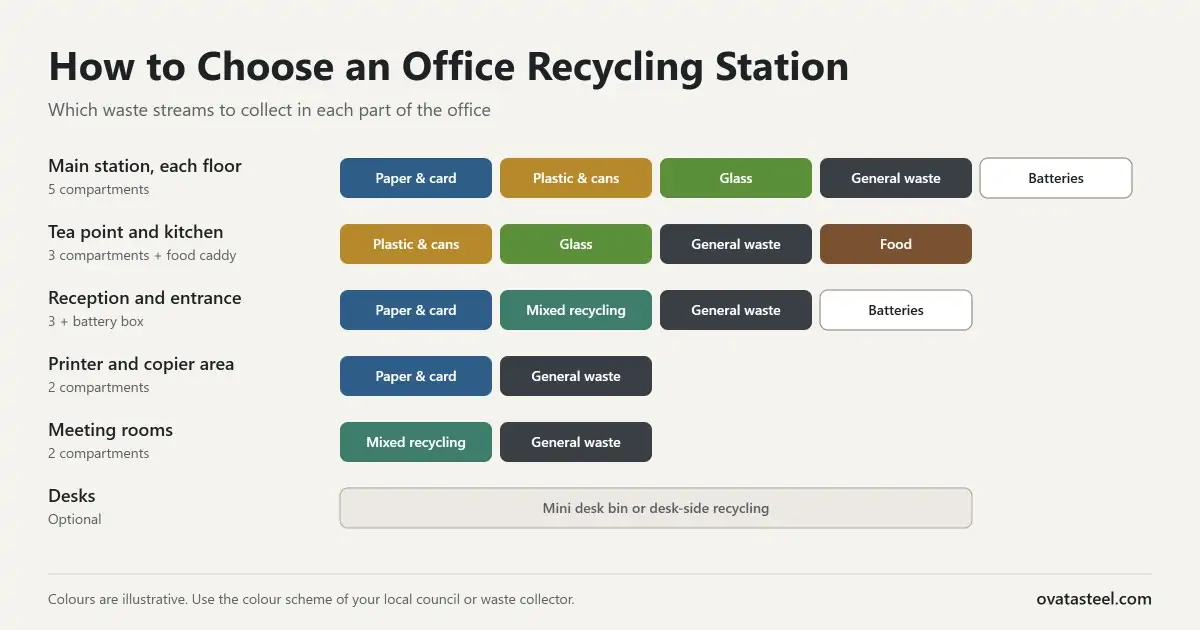
An office recycling station needs one compartment for each stream your collector takes separately, plus one for general waste. Two compartments suit offices with mixed dry recycling, three or four suit offices that separate paper, plastic, glass and metal, and five allow an extra stream such as batteries.
| Compartments | Typical streams | Where it fits |
|---|---|---|
| 2 | Mixed dry recycling + general waste | Small offices, meeting rooms, corridors |
| 3 | Paper and card + mixed recycling + general waste | Open-plan zones, printer areas |
| 4 | Paper, plastic and cans, glass + general waste (or food at tea points) | Tea points, kitchens, reception |
| 5 | Four streams + batteries or another stream | Main stations on each floor, shared kitchens |
Food waste usually needs its own lidded caddy or bin at tea points and kitchens, because it is emptied more often than dry recycling. If your office collects batteries, a station with a built-in battery box keeps them out of the other streams.
Where to put recycling stations in an office
Put recycling stations where waste is created and where people already walk. Tea points and kitchens, printer and copier areas, reception, meeting room corridors and lift lobbies are the usual places. A station that people have to detour to will collect less, and what it does collect will be more contaminated.
- Tea points and kitchens: the main source of cups, bottles, cans and food waste. Place the most complete station here.
- Printer and copier areas: mostly paper and card, so a paper compartment and a general waste opening are often enough.
- Reception and entrances: visitors’ waste counts too in England. A station here also shows visitors how the building sorts waste.
- Meeting rooms: a small two-compartment bin, or a central station in the corridor outside.
- Same layout on every floor: put stations in the same position on each floor so people know where to look.
- Measure first: multi-compartment stations are wider than single bins. Check the wall width and keep walkways and doors clear.
How big should office recycling bins be?
Size each compartment for the amount of that stream that builds up between two emptying rounds. There is no reliable universal figure per employee, because waste depends on whether people eat in the office, how much they print and how often bins are emptied. A one-week waste count gives a far better answer.
- Count for a week: note how many bags of each stream are collected from each area.
- Match the cleaning schedule: divide by the number of emptying rounds to get the volume per round.
- Leave headroom: a bin that overflows before it is emptied pushes recyclables into general waste.
- Size by stream: paper and mixed recycling fill faster at printers and tea points; general waste fills faster in kitchens.
For reference, the inner buckets in Ovata Steel’s multi-compartment stations hold 40 or 45 litres each, depending on the model.
Labels, colours and signage
Clear labels matter as much as the bins. Each opening should show the stream name, a pictogram and the local colour, in the language or languages people on site read. Colour alone is not enough: colour schemes differ between countries and councils, and some people cannot tell colours apart.
- Follow the local scheme: match your collector’s colours, or the building’s existing bins. Our guide to recycling bin colour codes by country compares the UK, EU, Gulf and Türkiye.
- Show examples: list or show the common items for each stream, such as cups, bottles, cans and paper.
- Keep it consistent: use the same order of streams and the same labels at every station in the building.
- Plan for EU labels: under Regulation (EU) 2025/40, waste receptacles will carry harmonised sorting labels from 12 August 2028 at the earliest. A replaceable label area makes that change easier.
Metal or plastic: choosing the material and features
Office recycling stations are usually made of plastic, powder-coated steel or stainless steel. Metal stations are heavier and more rigid, which helps in busy kitchens and receptions, and steel is non-combustible. Whichever material you choose, look for removable inner buckets, bag clips and a finish that wipes clean.
- Powder-coated steel: a durable painted finish for indoor offices.
- Stainless steel: suits kitchens and areas that are cleaned often.
- Inner buckets: removable buckets make emptying and cleaning quicker than lifting bags out of a fixed body.
- Bag clips: stop liners slipping into the bucket.
- Lids and openings: open tops are quick to use; lids hide contents and reduce smells at food bins.
- Footprint: check width, height and depth against the space you have.
Ovata Steel office recycling stations
Ovata Steel manufactures metal recycling stations in Istanbul, Türkiye, with powder-coated steel bodies and removable inner buckets. Stainless steel models are also available. Several models include a battery box for waste batteries.
| Model | Compartments | Size | Inner buckets | Suggested place |
|---|---|---|---|---|
| Ovata-420 | 2 | 30 × 90 × 70 cm | 2 × 45 L | Meeting rooms, small offices |
| Ovata-437 | 3 + battery box | 27 × 73 × 70 cm | 3 × 40 L | Reception, open-plan zones |
| Ovata-433 | 4 + battery box | 27 × 97 × 70 cm | 4 × 40 L | Tea points, main corridors |
| Ovata-432 | 5 + battery box | 27 × 120 × 70 cm | 5 × 40 L | Main station on each floor |
See the full recycling bins range, or single waste bins for individual rooms. We export to every country. To request a quote, send the models or number of compartments, the stream for each compartment, the quantity and the delivery country; the price and delivery time are confirmed in the quote.
Frequently Asked Questions
What is an office recycling station?
An office recycling station is a multi-compartment unit that collects several waste streams, such as paper, plastic and cans, glass and general waste, in one place. It replaces scattered single bins with a central point that is easier to label, empty and keep clean.
How many compartments should an office recycling station have?
One compartment for each stream your waste collector takes separately, plus one for general waste. Two compartments suit mixed dry recycling, three or four suit offices that separate paper, plastic, glass and metal, and five allow an extra stream such as batteries.
Should offices remove desk bins?
Not necessarily. The University of Queensland raised its recycling rate from 10 to 27 per cent after replacing under-desk bins with central stations and mini desk bins. A Keep America Beautiful study raised office recycling by 20 per cent with desk-side recycling bins and small trash bins.
Where should recycling bins go in an office?
Where waste is created and people already pass: tea points and kitchens, printer and copier areas, reception, meeting room corridors and lift lobbies. Put stations in the same position on each floor, and keep walkways and doors clear.
Do offices in England have to recycle?
Yes. Under Simpler Recycling, workplaces in England with 10 or more full-time equivalent employees have had to separate general waste, dry recycling and food waste since 31 March 2025. Micro-firms with fewer than 10 employees have until 31 March 2027.
How big should office recycling bins be?
Large enough to hold each stream between two emptying rounds. Count the bags of each stream collected from each area over one week, divide by the number of emptying rounds and leave some headroom so bins do not overflow.
Are metal recycling stations better than plastic ones?
Metal stations are heavier and more rigid, and steel is non-combustible, which suits busy kitchens and receptions. Plastic stations are lighter. Whichever you choose, look for removable inner buckets, bag clips and a finish that is easy to clean.
What colours should office recycling bins be?
Follow the colour scheme of your local council or waste collector, because colours differ between countries and areas. Label each opening with the stream name and a pictogram as well, since colour alone does not tell everyone what goes where.
Sources
- Simpler recycling: workplace recycling in England – GOV.UK
- Simpler Recycling: changes for businesses – Wandsworth Council
- Changes to workplace recycling: guidance for workplaces – Welsh Government
- Recycling (including food waste) – Scottish Environment Protection Agency
- Gewerbeabfallverordnung – IHK Chemnitz
- Ministerial decision compels companies, institutions and complexes to sort waste – Gulf Times
- Keep America Beautiful announces results of “Recycling at Work” research study – 3BL Media, April 2015
- Central waste and recycling stations – University of Queensland Sustainability
- EU misses deadline for PPWR labelling rules – Envirotec, August 2026


One thought on “How to Choose an Office Recycling Station: Streams, Placement and Size”
Comments are closed.