


Powder-Coated vs Stainless Steel Litter Bins: Which Lasts Longer Outdoors?

Last updated: November 2026
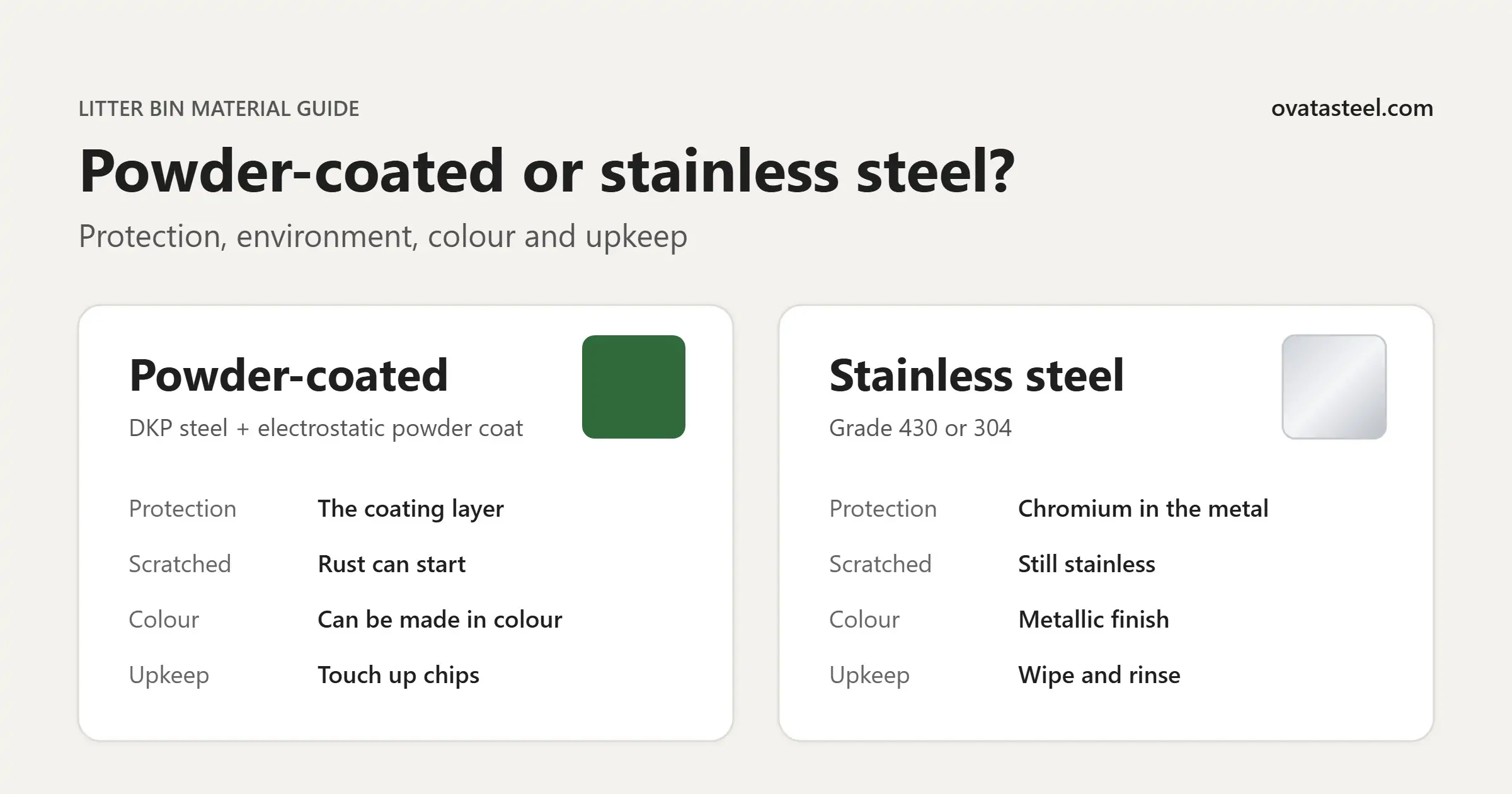
The main difference between a powder-coated and a stainless steel litter bin is where the protection comes from: on a powder-coated bin a layer of paint protects the steel, while on a stainless bin the protection is in the metal itself. A powder-coated bin performs well outdoors and comes in colour as long as the coating stays intact; where the coating is scratched through, rust can start. Which one is right depends on where the bin will stand, how much knocking it will take and how it will be maintained.
This guide explains how each material is protected, which environments suit which, what a galvanised undercoat adds, how maintenance differs and what to ask for in a quote or tender.
Powder-coated vs stainless steel: the short answer
Both materials work well in dry indoor areas, where the choice comes down to appearance and budget. In parks, gardens and streets, a powder-coated bin is a good option as long as its coating is kept intact. In washrooms, frequently hosed-down areas and places with a high risk of impact, stainless steel, especially grade 304, needs less maintenance.
| Feature | Powder-coated steel | Stainless steel |
|---|---|---|
| Base material | Carbon steel sheet (at Ovata, cold-rolled DKP sheet) | Stainless steel containing chromium (430 or 304) |
| What protects it | The powder coating on the surface | The chromium in the metal itself |
| When scratched | Bare steel is exposed and can rust | The scratch is still stainless steel |
| Colour | Can be made in colour | Metallic finish (brushed or polished) |
| Sunlight | Depends on the powder; outdoor use needs a UV-resistant type | No fading |
| Coastal sites | Rust spreads faster once the coating is damaged | 304 can stain; needs regular washing |
| Maintenance | Touching up chips and scratches | Regular wiping and rinsing |
| Cost | Usually lower | Usually higher |
What is a powder-coated steel litter bin?
A powder-coated litter bin is made from steel sheet that is coated with electrostatically applied powder and then cured in an oven. According to Products Finishing magazine, powder coating is a dry process: electrically charged powder particles cling to the earthed part, then melt and flow into a continuous film in the oven. Once cured, a thermoset powder does not soften when it is reheated.
How long the coating lasts depends heavily on surface preparation before painting. Pretreatment removes oil, dirt and rust from the surface; iron phosphate is common on steel and zinc phosphate on galvanised surfaces. According to the US Environmental Protection Agency (EPA), powder coatings contain no solvents and release no volatile organic compounds (VOCs).
On Ovata’s powder-coated products the base material is DKP sheet: cold-rolled carbon steel with no zinc or other metallic coating. That means the powder coating is the only layer protecting the steel from the weather.
What is a stainless steel litter bin?
Under the European standard EN 10088, stainless steel is steel with at least 10.5% chromium; grades 430 and 304, the two most common in bins, contain roughly 16–19.5%. The chromium forms a thin protective film on the surface that re-forms when it is scratched. Grade 430 is an economical choice for dry indoor areas, while 304 performs better in wet and outdoor locations.
The composition of the two grades, the magnet test and which grade to choose for each location are covered in a separate guide: 430 vs 304 stainless steel: what it means for your bins.
The real difference: protection in the coating or in the metal
Paint protects steel only as a barrier. According to the Hot Dip Galvanizers Association Southern Africa, the most common failure of barrier-only coatings is rust that starts at a damaged spot and creeps underneath the paint film. On stainless steel the protection is part of the metal, so a scratch does not change the fact that the bin is stainless.
In practice this looks like this: a powder-coated bin in a park or school yard that is kicked, cut or chipped during handling can start to show rust at that spot. If the damage is noticed early and touched up, the problem stays small. On a stainless bin a scratch spoils the look but does not start corrosion, although carbon steel dust left on the surface can cause brown staining.
Choosing by environment: ISO 12944 corrosivity categories
The international paint standard ISO 12944-2 groups environments by how corrosive they are, from C1 to C5. Heated, clean buildings such as offices and schools are C1; urban areas and coastal areas with low salinity are C3; swimming pools and coastal areas with moderate salinity are C4; coastal areas with high salinity are C5. The higher the category, the more the integrity of the coating matters on painted steel.
| Category | Example environment | Powder-coated bin | Stainless bin |
|---|---|---|---|
| C1 (very low) | Heated offices, shops, schools, hotel interiors | Suitable | Suitable (430 is enough) |
| C2 (low) | Unheated stores, sports halls; rural outdoor areas | Suitable | Suitable |
| C3 (medium) | Urban and industrial outdoor areas, low-salinity coast; humid production areas | Suitable; watch for coating damage | 304 recommended |
| C4 (high) | Swimming pools, chemical plants; moderate-salinity coast | Needs frequent checks and touch-ups | 304 with regular washing |
| C5 (very high) | High-salinity coast, areas with constant condensation | Consider a galvanised undercoat system | Higher grades (such as 316) may be needed |
The standard rates the durability of paint systems as low (2–5 years), medium (5–15 years) and high (more than 15 years). These figures are the expected time to the first major maintenance repaint; they are not a promise of service life.
Colour, sunlight and appearance
Colour is the biggest advantage of powder coating: a bin can match a corporate colour scheme, a landscape design or a recycling colour code. Outdoors, though, the type of powder matters. According to Products Finishing, polyester powders resist sunlight while epoxy powders do not; epoxy fades quickly and chalks under UV light.
A stainless bin keeps its appearance and does not fade; its look is set by a brushed (satin) or polished finish. If you need a colour-coded recycling layout in stainless steel, the colour is usually added with labels or coloured lids. Colour conventions differ from country to country; see recycling bin colour codes by country.
Galvanised undercoat and duplex systems
A system in which paint or powder is applied over galvanising (a zinc coating) is called a duplex system. Where the paint is damaged, the zinc acts as a sacrificial anode, protecting the steel and stopping rust from spreading under the paint. The American Galvanizers Association (AGA) states that a duplex system outperforms either coating on its own, and that its life can be 1.5 to 2.3 times the sum of the two.
Duplex systems are mainly considered for high-salinity coastal sites and industrial areas. Whether a particular product can be supplied with a galvanised undercoat, and how that affects the price, should be asked separately at the quotation stage.
Which material for which location?
The right material depends on where the bin will stand, the risk of impact and how it will be maintained. The table below is a starting point based on the corrosivity categories, not a fixed rule. For a project near the sea or exposed to salt air, describe the location to the manufacturer in detail before choosing.
| Location | Suggested material | Why |
|---|---|---|
| Offices, meeting rooms | Powder-coated or 430 stainless | Dry environment; choose by appearance. |
| School corridors | Powder-coated or stainless | Powder coating makes colour-coded recycling easy. |
| Washrooms, WCs, wet areas | 304 stainless | Constant moisture; coating damage starts rust. |
| Commercial kitchens, canteens | 304 stainless | Frequent washing and detergents. |
| Parks, gardens, residential sites | Powder-coated | Colour fits the landscape; touch up scratches. |
| Streets, squares, campuses | Powder-coated or 304 | Where impact risk is high, 304 needs less upkeep. |
| Poolside | 304 stainless | Chlorinated water splashes. |
| Seafront, marinas | 304 with frequent washing, or a painted system with a galvanised undercoat | Salt air; higher grades in severe conditions. |
Combining both: powder-coated body, stainless top
Some outdoor products use both materials, each where it works best. On an outdoor ashtray, for example, the body can be powder-coated steel while the top tray, which takes heat and ash, is stainless steel. This keeps the colour option for the main body and puts stainless steel on the part that is cleaned most often.
Ovata’s Ovata-214 is built this way, with an electrostatic polyester powder-coated steel tube body and a 304 stainless top ashtray. Ovata-300 has a 1 mm powder-coated DKP body with a 1.5 mm 304 stainless top.
Cleaning and maintenance
Maintenance on a powder-coated bin is about keeping the coating intact: spotting scratches early, touching them up with a suitable paint and avoiding abrasive cleaners. On a stainless bin it is about keeping the surface clean: wiping with warm water and mild detergent, rinsing and keeping bleach and steel wool away.
- Powder-coated: Wipe with a soft cloth and mild detergent; do not use abrasive powders or hard brushes.
- Powder-coated: Clean and touch up chipped spots promptly; it is far easier to act before rust creeps under the coating.
- Powder-coated: Do not let water collect in the base or the inner liner.
- Stainless: Wipe with warm water and mild detergent, rinse with clean water and dry.
- Stainless: Avoid bleach, chlorine-based cleaners and steel wool.
- Both: Clean more often outdoors and near the sea.
What to ask for in a quote or tender
To compare the two materials fairly, ask every supplier for the same information: sheet thickness, the powder type and pretreatment for coated products, and the grade (430 or 304) for stainless ones. Stating where the bins will be used, how far they are from the coast and how much impact they will take helps the manufacturer recommend the right material.
- Location: indoor, park, street, poolside or seafront
- Distance from the coast and climate (humidity, salt air)
- Sheet thickness, for the body and the inner liner separately
- For coated products: powder type (UV-resistant for outdoor use), pretreatment and colour
- Whether a galvanised undercoat is available
- For stainless products: grade 430 or 304
- Ground fixing, inner liner and lid requirements
- Quantity and delivery country and city
Ovata’s powder-coated and stainless options
Ovata Steel manufactures most of its outdoor and recycling products from DKP sheet with an electrostatic oven-baked powder coating, and makes its stainless products in grade 430 or 304 at the customer’s request. Sheet thickness and dimensions are listed on each product page. Ovata exports from Türkiye; delivery time and price are set in the quotation, so include your location and quantities when you ask.
- Powder-coated outdoor bins: Ovata-619 (40 × 40 × 105 cm, 0.80 mm DKP sheet), Ovata-618 (30 × 30 × 70 cm, 0.80 mm DKP body) and Ovata-607 (2 mm flat-bar cage body, 0.80 mm DKP inner bin). See all outdoor trash bins.
- Wood-clad models: the metal parts are electrostatic powder-coated and the hornbeam slats have a water-based finish, as on Ovata-707. See all wooden trash cans.
- Recycling bins: the powder-coated Ovata-401 (0.80 mm DKP body, 4 × 45 litre inner bins). See all recycling bins.
- Stainless and mixed-material ashtrays: Ovata-204 (0.60 mm 430 stainless body), plus Ovata-214 and Ovata-300 above. See all outdoor ashtrays.
To compare both materials for your site, send your project details through the contact page.
Frequently Asked Questions
Do powder-coated litter bins rust?
As long as the coating is intact, the steel is protected. If the coating is scratched or chipped, the exposed steel can rust, and without a galvanised undercoat the rust can spread under the paint. Touching up scratches early greatly reduces this risk.
Is powder-coated or stainless steel better outdoors?
In parks, gardens and urban areas a powder-coated bin is a good choice as long as its coating is maintained, and it offers colour. In areas with high impact risk, frequent washing or chlorinated water, 304 stainless needs less maintenance. On high-salinity coasts both options need extra measures.
What is electrostatic powder coating?
It is a finishing method in which electrically charged powder is sprayed onto an earthed metal part and then melted in an oven to form a continuous coating. It is a dry process; according to the US EPA, powder coatings contain no solvents and release no VOCs. Its durability depends on surface preparation.
What is DKP steel sheet?
DKP is cold-rolled carbon steel sheet with no zinc or other metallic coating. It forms well and takes paint well. Because it does not resist rust on its own, products such as litter bins made from it are protected by a coating.
Which material should I choose for a seafront site?
Salt air is hard on both materials. 304 stainless can be used with regular freshwater washing; severe conditions may call for higher grades such as 316. On painted steel, a duplex system with a galvanised undercoat limits how far rust spreads when the coating is damaged. Describe the site in detail in your quote request.
Will a powder-coated bin fade in the sun?
That depends on the powder. According to Products Finishing, polyester powders resist sunlight, while epoxy fades quickly and chalks under UV light. When requesting a quote for outdoor bins, ask whether a UV-resistant outdoor powder is used.
How do I repair a scratched powder-coated bin?
Clean the scratched area, remove any rust, let it dry and cover it with a suitable touch-up paint. Asking the manufacturer for the colour and powder type gives the closest match. The sooner you act, the lower the risk of rust spreading under the coating.
Is a powder-coated bin cheaper than a stainless one?
A powder-coated carbon steel bin usually costs less than a stainless bin of the same size. Maintenance should be included in the total cost, though: busy areas where bins take knocks need more touch-ups. For an exact comparison, ask for quotes on the same model and thickness in both materials.

