


How Many Recycling Bins Does a School Need?

Last updated: October 2026
There is no official number of recycling bins per pupil: a school needs enough school recycling bins to give every area where waste is produced a bin for each stream it creates. In practice that means a paper bin in every classroom, a multi-stream station on each corridor or floor, food waste and mixed recycling in the canteen, and paired bins outdoors, sized from a one-week waste check.
This guide sets out what the rules require in England, Wales and Scotland, which bins each area of a school needs, a worked example of counting bins for one school, and how to size them.
How many recycling bins does a school need? The short answer
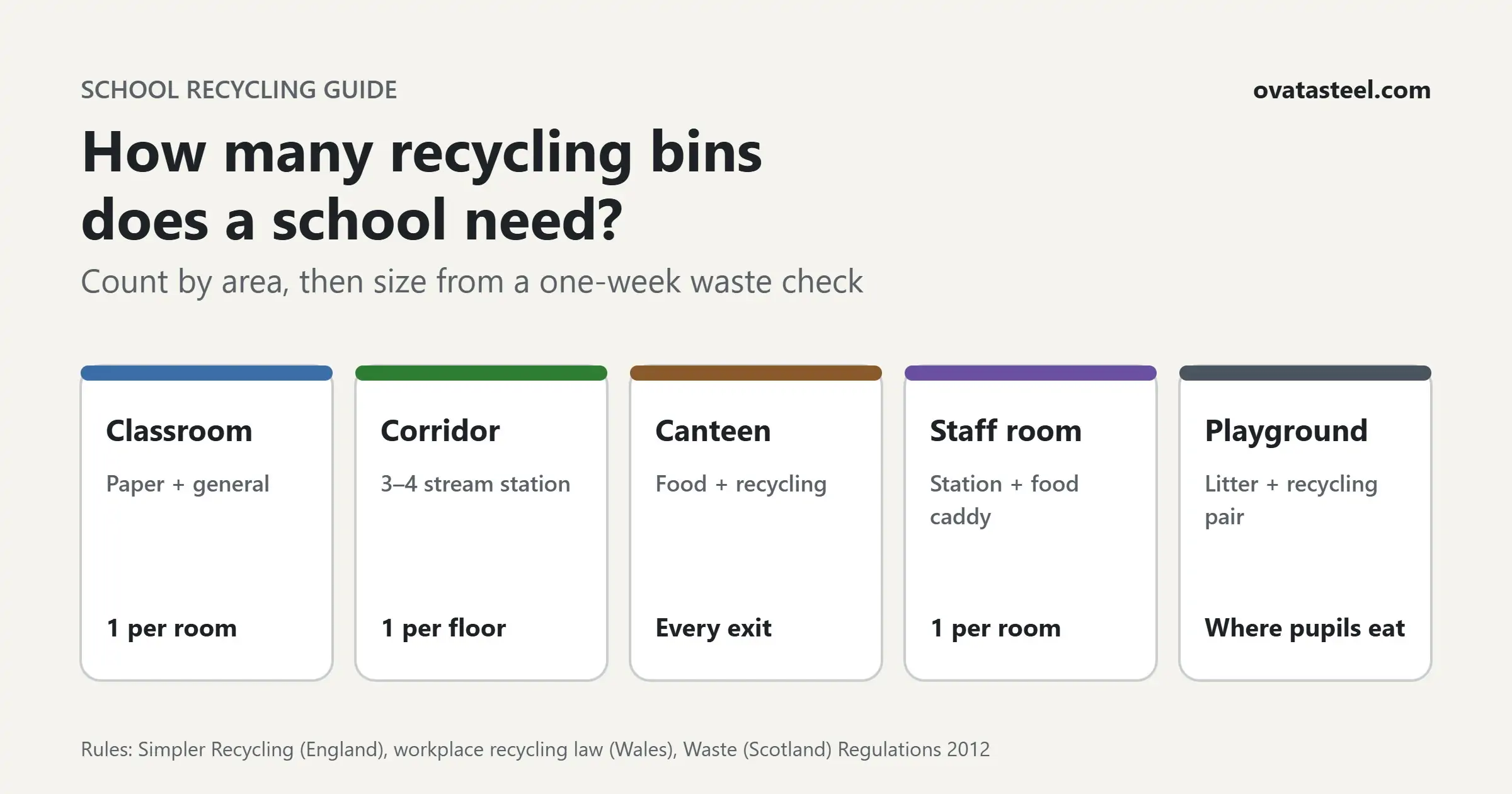
Count by area, not by pupil numbers. Each classroom needs at least paper and general waste, each corridor or floor one station that separates the main streams, the canteen food waste plus mixed recycling at every exit, staff rooms a small station and a food caddy, and outdoor areas paired litter and recycling bins where people gather.
The total therefore depends on how many rooms, floors, entrances and eating areas the school has. A one-week check of how much each area fills then tells you which bin sizes to choose and how often they need emptying.
What the rules require in England, Wales and Scotland
All three nations require schools to separate recyclable waste, but the streams and dates differ. In England, Simpler Recycling has applied to schools since 31 March 2025. In Wales, the workplace recycling law has covered state and private schools since 6 April 2024. In Scotland, the Waste (Scotland) Regulations 2012 apply.
| Nation | In force | Streams to separate | Food waste |
|---|---|---|---|
| England (Simpler Recycling) | 31 March 2025; organisations with fewer than 10 full-time equivalent employees by 31 March 2027 | Dry recyclables (plastic, metal, glass, paper and card), food waste, residual waste; paper and card separate unless the collector has a written co-collection assessment | Required even where there is no kitchen |
| Wales (workplace recycling) | 6 April 2024 | Paper and card; glass; metal, plastic, cartons and similar packaging such as coffee cups; unsold small electricals and textiles | Required at 5 kg or more in any seven days; no food waste down sinks or drains |
| Scotland (Waste (Scotland) Regulations 2012) | In force | Glass, metals, plastics, paper and card presented separately | Schools count as food businesses; required at 5 kg or more a week, with an exemption for rural premises |
In England, the GOV.UK guidance also covers bins for customers and visitors, which in a school means visitors, parents and pupils in shared areas. In Wales, the Welsh Government guide for schools adds practical points: label bins, keep storage away from food preparation areas and never block escape routes.
School recycling bins by area
Each area of a school produces a different mix of waste, so the bins should follow the waste. The Welsh Government guide notes that classrooms mainly produce paper and food waste, staff rooms paper and packaging, and outdoor grounds food and packaging. The table below turns that into a starting set-up for each area.
| Area | Main waste | Suggested set-up | How many |
|---|---|---|---|
| Classroom | Paper, some packaging and food | Paper bin plus general waste, or a 2-compartment bin | One per classroom |
| Corridor, stairwell, entrance hall | Bottles, cans, snack packaging, paper | 3- or 4-compartment station | One per corridor or floor, plus one at each main entrance |
| Canteen, dining hall | Food waste, drink containers, packaging | Food waste, mixed recycling and general waste together | One set at each exit or tray return point |
| Kitchen | Food preparation waste, cardboard | Sealed food waste containers; separate cardboard collection | Per kitchen, kept apart from front-of-house bins |
| Staff room, offices | Paper, packaging, food | Small multi-stream station plus food caddy | One per staff room |
| Library, IT rooms | Paper, batteries, small electricals | Paper bin; battery box at a central point | One paper bin per room; one battery point per building |
| Playground, sports fields | Food and packaging | Litter bin paired with a recycling bin | At gates, benches and where pupils eat |
Classrooms
A classroom mostly produces paper, so a paper bin next to the teacher’s desk or printer does most of the work. Add a general waste bin, or use one 2-compartment bin for both. Where pupils eat snacks in class, consider a small mixed recycling bin; under Simpler Recycling in England, food waste must also be collected even without a kitchen.
Keep classroom bins small, light and stable so pupils can use them safely, and empty them into the corridor or central bins at the end of the day.
Corridors, entrances and stairs
Corridors and entrance halls are where pupils throw away bottles, cans and snack packaging between lessons. A 3- or 4-compartment station on each corridor or floor, placed near stairs or toilets where traffic is heaviest, covers paper, mixed recycling and general waste in one footprint. Add one at each main entrance for visitors and parents.
Stations must not narrow escape routes. The Welsh Government guide says bins should not obstruct routes, create fire hazards or block exits, so choose slim units and fix their positions with the site manager.
Canteen and kitchen
The canteen is where food waste builds up fastest. Place food waste, mixed recycling and general waste together at every exit or tray return point, so pupils can sort in one stop. Keep kitchen food waste separate from front-of-house bins, in strong, sealable, easy-to-clean containers that are emptied promptly, as the Welsh guidance advises.
Food waste must not go down sinks or drains in Wales, and in England food waste must be collected separately from other waste. Check with your collector how often food waste is collected; GOV.UK recommends weekly or fortnightly collection and no more than two weeks’ storage.
Staff rooms and offices
Staff rooms produce paper, drink containers, food packaging and food waste. A compact station with paper, mixed recycling and general waste, plus a small food caddy, usually covers one staff room. School offices follow the same pattern as any office, with paper as the main stream.
For office layouts, see our guide to choosing an office recycling station.
Playgrounds and outdoor areas
Outdoor areas collect food and packaging waste where pupils eat and gather. Pair every litter bin with a recycling bin so pupils always have both choices side by side, and place the pairs at gates, benches, sports pitches and outdoor eating spots. Outdoor bins need lids or covered openings so rain and birds stay out.
Choose outdoor bins that can be fixed to the ground and are built for weather and knocks. Our outdoor trash bins and wooden park and garden bins are made for these areas.
Worked example: counting bins for one school
The example below is illustrative, not a standard. It shows how the area-by-area method adds up for a school with 30 classrooms on two floors, four corridors, two main entrances, one canteen with two exits, one kitchen, two staff rooms, a library and a playground with four gathering points.
| Area | Quantity | Bins |
|---|---|---|
| Classrooms | 30 | 30 two-compartment bins (paper and general) |
| Corridors | 4 | 4 four-compartment stations |
| Main entrances | 2 | 2 three-compartment stations |
| Canteen exits | 2 | 2 sets: food waste, mixed recycling, general waste |
| Kitchen | 1 | Sealed food waste containers and a cardboard collection point |
| Staff rooms | 2 | 2 small stations and 2 food caddies |
| Library | 1 | 1 paper bin and 1 battery collection box |
| Playground | 4 points | 4 pairs of litter and recycling bins |
That gives around 50 bins and stations for this school, before any extras for sports halls or after-school clubs. A school with fewer rooms needs fewer; the method stays the same.
Sizing bins: a one-week waste check
The number of bins comes from the areas; their size comes from how much waste each area produces between emptyings. Run a one-week check: note how full each bin is at every emptying, then choose a capacity that holds the busiest day’s waste with room to spare. Repeat the check after a term, when routines have settled.
- Record, for each area, how many bags or bins fill up each day.
- Note the busiest days, such as days with events or packed lunches.
- Check food waste weight against the 5 kg per week thresholds used in Wales and Scotland.
- Match bin capacity to the cleaning schedule: if bins are emptied once a day, size for one day’s waste.
- Agree collection frequency with your waste collector for each stream.
Labels, colours and safety
Clear labels matter more than bin colour. Each opening should show the stream in words and pictures, with examples of what goes in and what does not, at a height pupils can read. Colours vary between councils and collectors, so match yours to your collector’s scheme and keep the same colours across the whole school.
For safety, choose bins without sharp edges, with stable bases and lids that do not trap fingers, and keep them out of escape routes. For colour schemes in different countries, see recycling bin colour codes by country.
Ovata recycling bins for schools
Ovata Steel manufactures metal recycling bins in Istanbul and exports to every country; price and lead time are set in the quote. For corridors, entrances and staff rooms, multi-compartment units separate the main streams in one footprint, and some models include a battery compartment.
- Ovata-420: 2 compartments, 30 × 90 × 70 cm, 2 × 45 litres. Suits classrooms and small staff rooms.
- Ovata-437: 3 compartments plus battery box, 27 × 73 × 70 cm, 3 × 40 litres. Suits entrances and staff rooms.
- Ovata-433: 4 compartments plus battery box, 27 × 97 × 70 cm, 4 × 40 litres. Suits corridors.
- Ovata-432: 5 compartments plus battery box, 27 × 120 × 70 cm, 5 × 40 litres. Suits busy halls and canteen exits.
See all recycling bins and battery waste boxes, or send us your room count and we can quote for the whole school.
Frequently Asked Questions
How many recycling bins does a school need?
There is no official ratio. Count by area: one bin in every classroom, one multi-stream station per corridor or floor and at each main entrance, food waste and mixed recycling at each canteen exit, a small station in each staff room, and paired bins outdoors. Then size the bins from a one-week waste check.
Do schools have to recycle in England?
Yes. Under Simpler Recycling, schools in England must separate dry recyclables, food waste and residual waste. The rules have applied since 31 March 2025; organisations with fewer than 10 full-time equivalent employees have until 31 March 2027. Food waste must be collected even where there is no kitchen.
What must schools in Wales separate?
Since 6 April 2024, schools in Wales must separate paper and card; glass; metal, plastic, cartons and similar packaging; food waste where they produce 5 kg or more in any seven days; and unsold small electricals and textiles. Food waste must not go down sinks or drains.
Do schools in Scotland have to separate food waste?
Schools count as food businesses under the Waste (Scotland) Regulations 2012. Those that consistently produce 5 kg or more of food waste a week must present it separately, with an exemption for premises in rural areas. Glass, metals, plastics, paper and card must also be presented separately.
What recycling bins does a classroom need?
Most classrooms need a paper bin and a general waste bin, or one 2-compartment bin. If pupils eat in class, add mixed recycling and make sure food waste has somewhere to go. Keep classroom bins small, stable and easy for pupils to use.
Where should recycling bins go in a school?
Put them where waste is produced: in classrooms, on each corridor near stairs and toilets, at main entrances, at canteen exits, in staff rooms and at outdoor gathering points. Keep them out of escape routes and away from food preparation areas.
What size of recycling bin does a school need?
Size each bin from a one-week check of how much waste that area produces between emptyings. If bins are emptied daily, choose a capacity that holds the busiest day’s waste with room to spare. Corridor and canteen bins usually need larger compartments than classroom bins.
How should school recycling bins be labelled?
Label every opening with the stream in words and pictures, plus examples of what goes in and what does not, at a height pupils can read. Use the same colours throughout the school and match them to your collector’s scheme, since colours vary between councils.

